☎ 484-832-6305
✉ info@autoclaimauthority.com
📍 Appraisal Services Available Nation Wide!
What Makes a Good Comparable Vehicle?
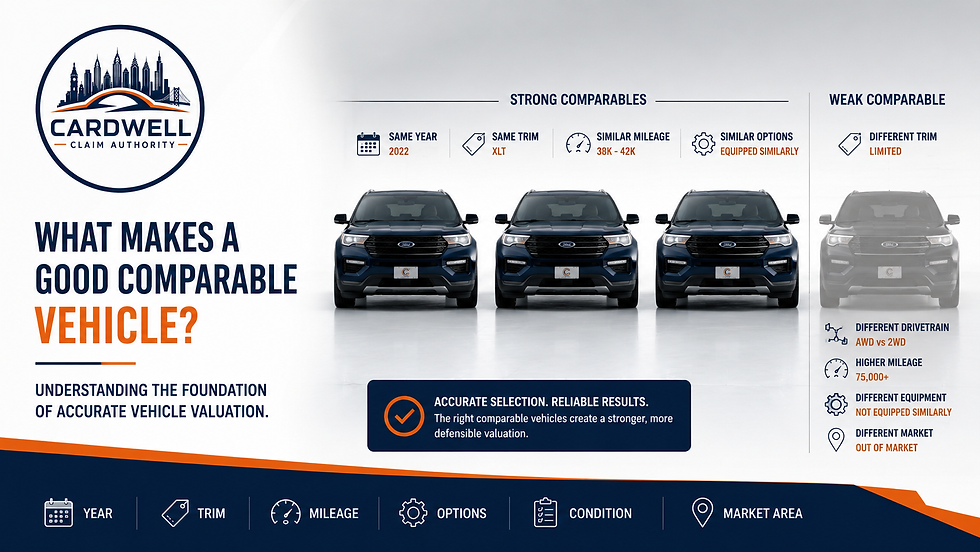
Understanding One of the Most Important Factors in Vehicle Valuation
When insurance companies, appraisers, dealers, and valuation professionals determine the value of a vehicle, one of the most important factors is the selection of comparable vehicles.
A valuation is only as reliable as the comparable vehicles used to support it.
Poor comparable vehicle selection can lead to inaccurate conclusions, while strong comparable vehicle selection helps create a valuation that is supported by real market evidence.
What Is A Comparable Vehicle?
A comparable vehicle is a vehicle that is sufficiently similar to the subject vehicle that its market value can help support an opinion of value.
The goal is not simply to find vehicles that look similar.
The goal is to find vehicles that would reasonably compete with the subject vehicle in the marketplace.
Year, Make, and Model Matter
The strongest comparable vehicles generally share the same:
-
Year
-
Make
-
Model
For example, a 2022 Toyota RAV4 XLE AWD should ideally be compared against other 2022 Toyota RAV4 XLE AWD vehicles.
When sufficient market data is unavailable, nearby model years may sometimes be considered, but adjustments and market differences should be carefully evaluated.
Trim Level Matters
One of the most common valuation errors involves trim level selection.
Many vehicles are available in multiple trims, including:
-
Base
-
Sport
-
Premium
-
Limited
-
Touring
-
Platinum
-
Performance variants
Two vehicles may appear identical while having thousands of dollars in value differences due to trim level alone.
Whenever possible, comparable vehicles should match the subject vehicle's trim level.
Drivetrain Matters
Drivetrain configuration can significantly impact market value.
Examples include:
-
Front-Wheel Drive (FWD)
-
Rear-Wheel Drive (RWD)
-
All-Wheel Drive (AWD)
-
Four-Wheel Drive (4WD)
In many markets, AWD and 4WD vehicles command higher values than similar two-wheel-drive vehicles.
Comparable vehicles should share the same drivetrain whenever possible.
Engine Configuration Matters
Engine options can have a substantial impact on market value.
Examples include:
-
Four-cylinder vs. V6
-
Naturally aspirated vs. turbocharged
-
Standard vs. high-output engines
-
Hybrid and plug-in hybrid systems
A vehicle with a larger or more desirable powertrain may compete in an entirely different market segment.
Mileage Matters
Mileage is one of the most significant factors affecting vehicle value.
A strong comparable vehicle should have mileage reasonably similar to the subject vehicle.
Significant mileage differences may require adjustments and can reduce the reliability of the comparison.
Mileage adjustments should reflect actual market behavior rather than arbitrary calculations.
Factory Equipment and Packages Matter
Optional equipment can significantly affect value.
Examples include:
-
Technology packages
-
Premium sound systems
-
Tow packages
-
Luxury packages
-
Performance packages
-
Off-road packages
-
Panoramic roofs
-
Driver assistance systems
Two otherwise identical vehicles may have materially different values because of optional equipment.
Accurate option identification is essential.
Geographic Market Matters
Vehicle values can vary significantly between markets.
Factors influencing regional value differences include:
-
Supply and demand
-
Climate
-
Seasonal trends
-
Local buyer preferences
-
Population density
A vehicle offered for sale hundreds of miles away may not reflect the same market conditions as the subject vehicle.
Whenever possible, comparable vehicles should come from the same or similar market area.
Vehicle Condition Matters
Condition remains an important valuation factor.
Areas commonly evaluated include:
-
Exterior condition
-
Interior condition
-
Paint quality
-
Tire condition
-
Mechanical condition
-
Prior damage
-
Maintenance history
Comparable vehicles should represent similar overall condition whenever possible.
Accident History Matters
A vehicle with a prior accident history may not compete directly with a vehicle that has a clean history.
Many buyers place value on a clean vehicle history report.
When available, accident history should be considered when selecting comparable vehicles.
Ownership History Can Matter
In certain market segments, ownership history may influence value.
Examples include:
-
One-owner vehicles
-
Fleet vehicles
-
Rental vehicles
-
Commercial-use vehicles
These factors may affect buyer demand and market perception.
Market Availability Matters
A vehicle may be technically comparable while failing to reflect actual market conditions.
The best comparable vehicles are not only similar to the subject vehicle—they are vehicles that a reasonable buyer would realistically consider purchasing instead.
Why Good Comparable Vehicles Matter
The selection of comparable vehicles often has a greater impact on value than any single adjustment.
Strong comparable vehicle selection creates a stronger valuation.
Weak comparable vehicle selection creates a weaker valuation.
This is one reason independent review can be valuable when valuation disputes arise.
The Cardwell Approach
At Cardwell Claim Authority, we believe comparable vehicle selection should be based on market evidence, not convenience.
Every valuation should be capable of being explained, documented, and supported.
We are not hired to create value.
We are not hired to reduce value.
We are hired to determine value based on evidence, market data, and professional appraisal methodology.
Mileage Accuracy
We prioritize vehicles with similar odometer readings, typically within a 10,000-mile variance, to ensure engine wear and tear parallels your own.
Trim & Options
Trim levels and added options like tech packages or solar roofs significantly affect value; we adjust strictly for feature parity.
Key Comparison Factors
A precise appraisal depends on selecting comparable vehicles that mirror your vehicle's specific market profile across these critical criteria.
Physical Condition
Comparables must be in like-condition, accounting for previous accidents, interior cleanliness, and regular maintenance records.
Geographic Proximity
Values shift by region. We search within a localized radius first (typically 50-100 miles) to reflect your actual local market value.
Model Year Range
Standard practice involves looking at the same year, or one year newer/older if the vehicle belongs to the same generation and body style.
Market Timing
Vehicle pricing is fluid. We use the most recent data seeds—generally within the last 90 days—to pinpoint the current fair market rate.