Understanding the CCC ValuScope Class Action Lawsuits: What Vehicle Owners Should Know
- thomascardwell8
- Jun 13
- 4 min read
When a vehicle is declared a total loss, one of the most important questions becomes:
"How was my vehicle's value determined?"
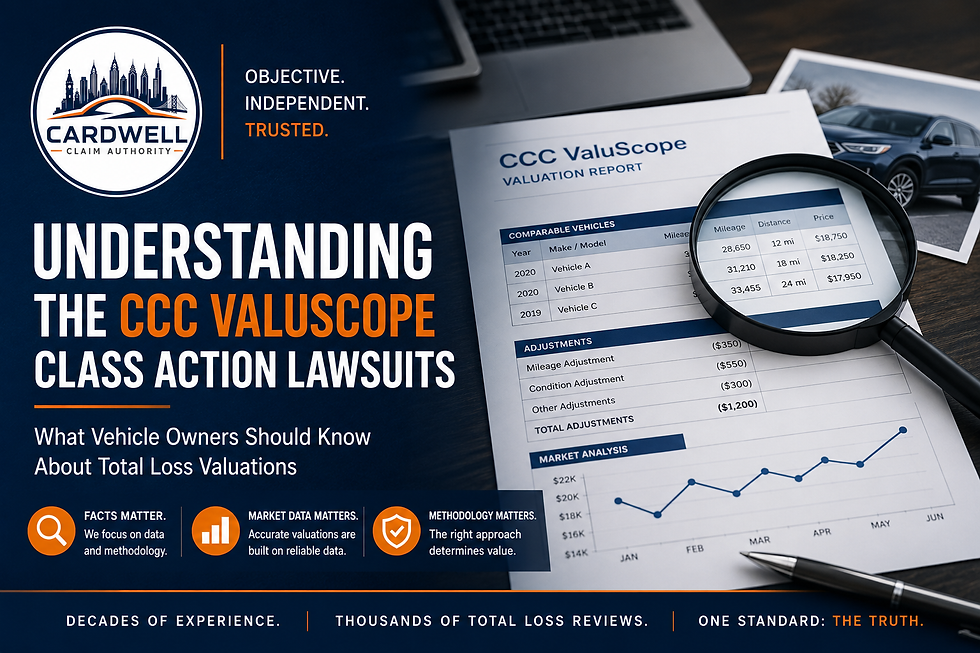
Many insurance companies utilize valuation reports generated through CCC Intelligent Solutions' ValuScope system as part of the total loss settlement process. Over the years, CCC and its valuation methodologies have been the subject of multiple class action lawsuits and legal challenges. As a result, many vehicle owners searching for information about their total loss settlement eventually encounter references to the CCC ValuScope lawsuits.
Understanding what these lawsuits were about—and what they mean for vehicle owners today—can help consumers make more informed decisions when reviewing a total loss valuation.
What Is CCC ValuScope?
CCC Intelligent Solutions is one of the largest providers of claims technology and vehicle valuation services used by insurance companies throughout the United States.
Its ValuScope reports are commonly used to help determine the Actual Cash Value (ACV) of a vehicle that has been declared a total loss. These reports generally rely on comparable vehicle data, vehicle condition adjustments, mileage adjustments, and market analysis to estimate a vehicle's value at the time of loss.
Many insurance carriers use CCC valuation reports as part of their settlement process, while others may utilize alternative valuation providers or additional market data sources.
What Were the CCC ValuScope Lawsuits About?
Several lawsuits filed in various jurisdictions challenged aspects of CCC's valuation methodology and the way certain adjustments were applied within total loss valuations.
While the allegations varied from case to case, common concerns raised by plaintiffs included:
Condition adjustments applied to comparable vehicles
Methodology used to determine comparable vehicle values
Certain deductions or adjustments reflected in valuation reports
Whether valuation reports accurately reflected true market conditions
Whether consumers received sufficient transparency regarding valuation calculations
These lawsuits generally focused on the valuation process itself rather than any single vehicle or claim.
What Did the Lawsuits Actually Prove?
One of the biggest misconceptions surrounding these lawsuits is the belief that they somehow proved every CCC valuation is inaccurate.
That is not what the litigation established.
The existence of a lawsuit does not automatically mean that every valuation generated by a particular system is incorrect. Likewise, a settlement or court ruling involving valuation practices does not mean that every total loss settlement was undervalued.
The legal challenges primarily highlighted concerns regarding specific valuation practices and whether certain methodologies complied with applicable laws and regulations.
As with many class action cases, the issues were often highly technical and focused on valuation procedures rather than individual claim outcomes.
Does This Mean My CCC Valuation Is Wrong?
Not necessarily.
Some CCC valuations are well supported and accurately reflect market conditions.
Others may contain issues that warrant further review.
The accuracy of any valuation depends on the quality of the underlying data and the methodology applied.
Potential areas that may affect a vehicle's value include:
Comparable Vehicle Selection
Are the comparable vehicles truly similar to the subject vehicle?
Mileage Adjustments
Have mileage differences been appropriately considered?
Vehicle Options
Were all factory-installed options properly identified?
Trim Level Accuracy
Was the correct trim package selected?
Condition Adjustments
Are condition adjustments reasonable and supported?
Local Market Conditions
Do the comparable vehicles reflect the actual market in which the vehicle would have been sold?
These factors can have a significant impact on a final valuation regardless of the software platform used.
Why Total Loss Valuations Are Frequently Disputed
Valuation disputes occur because determining market value is rarely as simple as entering information into a computer system.
Vehicle values can vary based on:
Geographic location
Vehicle condition
Trim level
Optional equipment
Mileage
Market demand
Comparable vehicle availability
Even small differences in these areas can affect a vehicle's value.
As a result, disputes often arise when vehicle owners believe important information was overlooked or when the selected comparable vehicles do not accurately represent the subject vehicle.
The Importance of Independent Review
Regardless of whether a valuation was prepared through CCC, Mitchell, Audatex, or another valuation platform, vehicle owners have the right to understand how their settlement value was determined.
An independent review can help verify:
Comparable vehicle accuracy
Option accuracy
Mileage treatment
Market support
Overall valuation methodology
The goal is not to increase or decrease a vehicle's value arbitrarily.
The goal is to determine whether the valuation is supported by the available market evidence.
The Cardwell Approach
At Cardwell Claim Authority, we believe every valuation should be capable of being explained, documented, and supported by real market data.
Vehicle values are not determined by software alone.
They are determined through the quality of the data, the comparable vehicles selected, the adjustments applied, and the methodology used to reach a final conclusion.
We do not create value. We determine value based on evidence, market data, and professional appraisal methodology.
Final Thoughts
The CCC ValuScope lawsuits brought attention to important questions regarding vehicle valuation methodology and transparency. However, they should not be viewed as proof that every valuation is incorrect or that every settlement is unfair.
The more important question is whether a specific valuation accurately reflects the vehicle being evaluated.
Every claim should be reviewed on its own merits.
When questions arise regarding a total loss valuation, the focus should remain on the evidence, the market data, and the methodology supporting the final value—not simply the software platform used to generate the report.


Comments