top of page
☎ 484-832-6305
✉ info@autoclaimauthority.com
📍 Appraisal Services Available Nation Wide!
Delaware Total Loss Appraisal Clause
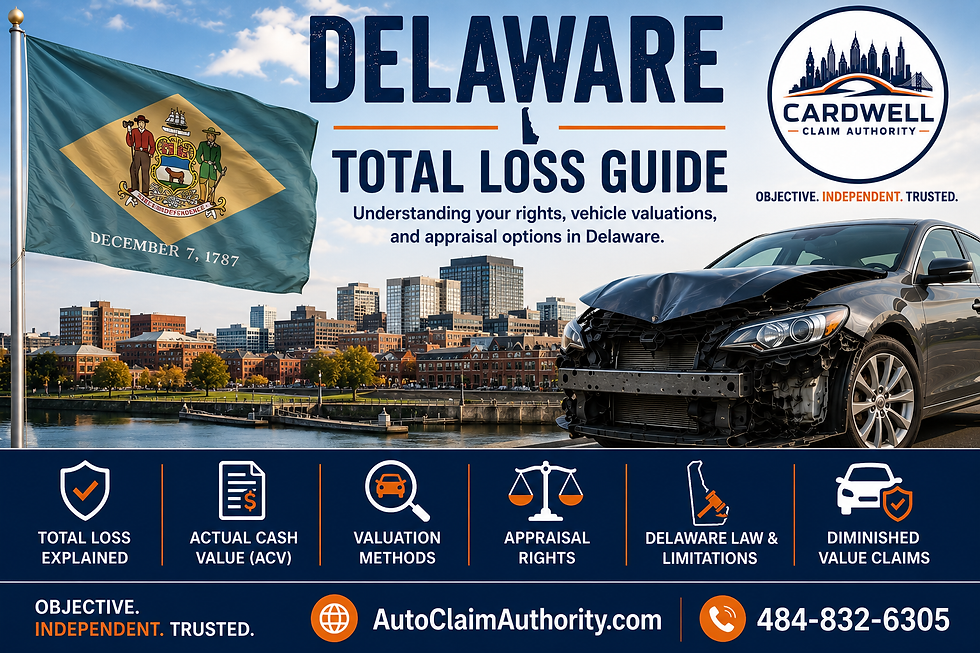
Delaware Total Loss Guide
Understanding Total Loss Valuations, Actual Cash Value, Appraisal Rights, and Vehicle Value Disputes in Delaware
When a vehicle is declared a total loss in Delaware, the disagreement is often not about whether the vehicle should be repaired.
The disagreement is usually about value.
Many vehicle owners are surprised to learn that the settlement amount offered by an insurance company is not based on the vehicle's original purchase price, loan balance, or replacement cost. Instead, insurers must determine the vehicle's Actual Cash Value (ACV) immediately before the loss occurred.
Understanding how total loss claims are evaluated in Delaware can help vehicle owners better understand the settlement process, identify potential valuation concerns, and make informed decisions when reviewing a total loss offer.
Delaware Total Loss Quick Facts
Total Loss Rule: Total Loss Formula (TLF)
Total Loss Threshold: Economic Total Loss Determination
Appraisal Clause: Available in many policies
Property Damage Statute of Limitations: Generally 2 Years
Diminished Value Claims: Recognized in appropriate circumstances
Common Valuation Systems: CCC, Mitchell, Audatex, J.D. Power, Black Book
Salvage Retention: Generally permitted
Delaware Total Loss Threshold
Delaware generally utilizes a Total Loss Formula when determining whether a vehicle is economically repairable.
A vehicle may be declared a total loss when:
Cost of Repairs + Salvage Value ≥ Actual Cash Value (ACV)
Rather than relying solely on a fixed percentage threshold, insurers typically evaluate whether repairing the vehicle is economically reasonable when compared to its pre-loss value.
Example
Actual Cash Value (ACV): $18,000
Repair Cost: $13,500
Salvage Value: $5,000
Total Loss Formula:
$13,500 + $5,000 = $18,500
Because the combined repair cost and salvage value exceed the vehicle's actual cash value, the insurer may determine that the vehicle is a total loss.
What Is Actual Cash Value (ACV)?
Actual Cash Value, commonly referred to as ACV, represents the fair market value of a vehicle immediately before the loss occurred.
Actual Cash Value is not:
-
The amount originally paid for the vehicle
-
The remaining loan balance
-
The cost to purchase a brand-new replacement vehicle
-
The highest asking price found online
Instead, ACV is intended to reflect what a willing buyer would reasonably pay for the vehicle in the open market immediately before the accident or loss.
When determining Actual Cash Value, insurers commonly consider:
-
Year, make, and model
-
Trim level
-
Mileage
-
Factory-installed options
-
Vehicle condition
-
Prior damage history
-
Local market conditions
-
Comparable vehicle sales and listings
Acceptable Vehicle Valuation Methods in Delaware
Delaware does not require insurers to use a single valuation provider or methodology.
Depending upon the vehicle and claim circumstances, insurers and appraisers may utilize one or more accepted valuation approaches.
1. Comparable Vehicle Market Analysis
Comparable vehicle analysis remains one of the most widely accepted methods of determining vehicle value.
This approach analyzes similar vehicles currently available in the marketplace and adjusts for differences in:
-
Mileage
-
Trim level
-
Factory options
-
Condition
-
Geographic location
Because this methodology relies upon actual market evidence, it is often considered one of the strongest methods of determining fair market value.
2. Third-Party Valuation Services
Many insurers utilize third-party valuation systems to develop total loss valuations.
Common examples include:
-
CCC Intelligent Solutions
-
Mitchell International
-
Audatex
These systems utilize proprietary databases, market information, comparable vehicles, and adjustment methodologies to estimate vehicle value.
3. Guide Source Valuation
Pricing guides may also be referenced when determining value.
Examples include:
-
J.D. Power
-
Black Book
Guidebooks can provide useful market information but may not fully reflect the unique characteristics of an individual vehicle.
4. Professional Appraisal
Independent appraisers may develop market value opinions using recognized appraisal methodology, vehicle inspections, market research, comparable vehicle analysis, and documentation review.
Professional appraisals are frequently utilized when vehicle owners dispute an insurer's valuation.
5. Dealer Market Research
For specialty, collector, antique, exotic, or difficult-to-value vehicles, dealer quotations and direct market research may be utilized.
Understanding Comparable Vehicles
Most total loss valuations ultimately rely upon comparable vehicle analysis.
Comparable vehicles are vehicles similar to the subject vehicle that are currently offered for sale or recently sold.
A quality comparable should closely match the subject vehicle in:
Year
The same model year whenever possible.
Make and Model
The same make and model.
Trim Level
Trim differences can significantly affect value.
Mileage
Mileage remains one of the most influential valuation factors.
Factory Options
Equipment differences may materially impact value.
Condition
Vehicle condition should be considered when comparing vehicles.
Geographic Market
Comparable vehicles should reasonably reflect the Delaware market where replacement vehicles would typically be purchased.
Common Valuation Problems
Many total loss disputes arise because of issues involving comparable vehicle selection.
Examples include:
-
Incorrect trim levels
-
Missing factory options
-
Excessive mileage differences
-
Prior accident history
-
Rental or fleet history
-
Improper condition adjustments
-
Comparable vehicles located outside the relevant market area
Generally speaking, the strongest valuation requires the fewest assumptions because the comparable vehicles already closely resemble the subject vehicle.
What Is Salvage Value?
Salvage value is the amount a damaged vehicle is expected to bring when sold after being declared a total loss.
Insurers frequently obtain salvage bids from licensed salvage buyers and auction companies.
Factors influencing salvage value include:
-
Extent of damage
-
Vehicle age
-
Vehicle popularity
-
Parts demand
-
Mechanical condition
-
Current auction market conditions
Can I Keep My Totaled Vehicle?
In many situations, Delaware vehicle owners may elect to retain ownership of a totaled vehicle.
If the owner chooses to keep the vehicle, the insurance company typically deducts the salvage value from the settlement payment.
Example
Actual Cash Value: $15,000
Salvage Value: $3,500
Settlement Payment:
$15,000 − $3,500 = $11,500
The owner receives the reduced settlement amount and retains the vehicle.
Delaware Appraisal Clause
Many Delaware automobile insurance policies contain an appraisal clause.
The appraisal clause provides a method for resolving disputes involving vehicle value.
Although policy language varies, the process generally follows the same structure:
-
Insurance company issues valuation.
-
Policyholder disagrees with value.
-
Appraisal clause is invoked.
-
Each side selects an appraiser.
-
An umpire may be selected if necessary.
-
A value determination is reached.
The appraisal clause is intended to resolve disputes concerning value rather than questions of coverage.
Delaware Statute of Limitations
Delaware generally applies a two-year statute of limitations for property damage claims arising from motor vehicle accidents.
Vehicle owners should also review their insurance policy for any contractual notice requirements or appraisal provisions that may affect timing.
Prompt action is always recommended when disputing a vehicle valuation.
Delaware Diminished Value Claims
Delaware recognizes diminished value claims in appropriate circumstances.
Even after proper repairs have been completed, a vehicle may suffer a measurable reduction in market value due to accident history.
Factors commonly considered include:
-
Vehicle age
-
Mileage
-
Severity of damage
-
Structural repairs
-
Market stigma
-
Vehicle segment
-
Prior accident history
Key Delaware Total Loss Facts
-
Delaware utilizes a Total Loss Formula.
-
Actual Cash Value represents fair market value immediately before the loss.
-
Comparable vehicle analysis remains one of the most widely accepted valuation methodologies.
-
Many policies contain appraisal clause provisions.
-
Delaware generally applies a two-year statute of limitations for property damage claims.
-
Salvage value plays a role in determining whether a vehicle is economically repairable.
-
Diminished value claims may be available depending on the circumstances of the claim.
Why Understanding the Process Matters
Most total loss disputes are not caused by bad faith or misconduct.
More commonly, they arise because reasonable people disagree about value.
Vehicle valuation involves market data, comparable vehicle selection, condition assessments, mileage considerations, and valuation methodology. Small differences in these factors can sometimes produce significant differences in value.
Understanding how total loss claims are evaluated allows vehicle owners to better review a settlement offer, identify potential concerns, and make informed decisions regarding their claim.
At Cardwell Claim Authority, our role is not to create value.
Our role is to determine value based upon market evidence, documented vehicle characteristics, and professional appraisal methodology.
Objective. Independent. Trusted.
bottom of page